DMPK and PK/PD in Drug Discovery: Principles, Strategy, and Translation

Uncategorized
Wishlist Share

About Course

DMPK and PK/PD in Drug Discovery: Principles, Strategy, and Translation is a comprehensive, self-paced course designed to build a practical understanding of how drug disposition, systemic and tissue exposure, pharmacological response, and biomarkers influence drug discovery and development decisions.
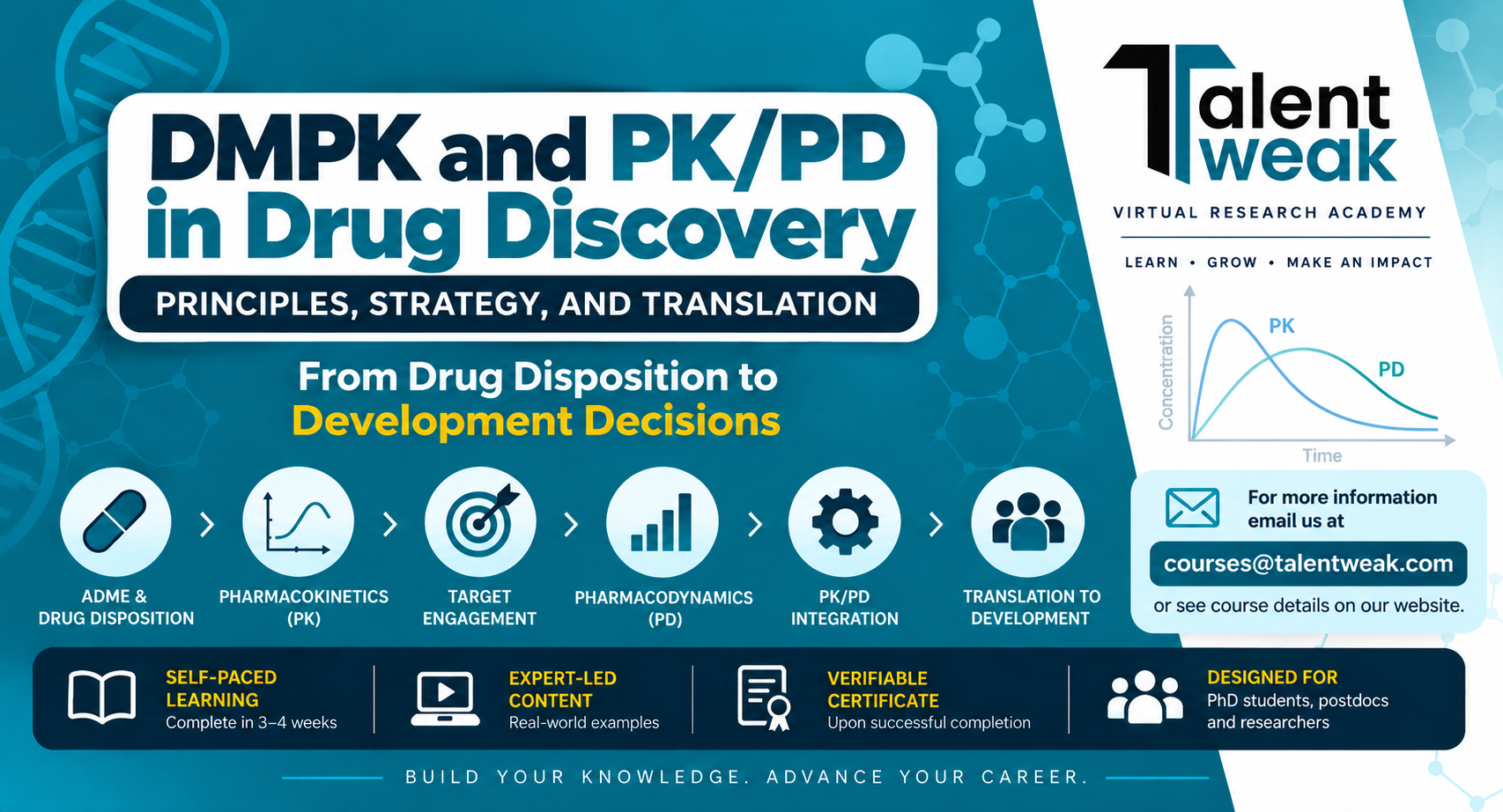
Designed for PhD students, postdoctoral researchers, pharmacologists, biologists, preclinical scientists, and professionals interested in pharmaceutical and biotechnology drug discovery, this course connects fundamental DMPK and PK/PD principles with real-world preclinical and translational applications.

Through six structured modules, you will explore:

  • The role of DMPK and pharmacokinetics in drug discovery
  • ADME, drug disposition, metabolism, distribution, and clearance
  • Preclinical PK study design and interpretation
  • Pharmacodynamics, target engagement, and biomarker strategies
  • PK/PD integration and exposure–response relationships
  • Translational DMPK, dose selection, and development decision-making

Real-world examples, published research, representative datasets, scientific case studies, quizzes, and curated learning materials are integrated throughout the course.

By the end of the course, you will be able to understand and interpret key DMPK, PK, PD, biomarker, and exposure–response concepts and recognize how these data are integrated to support drug discovery, candidate selection, and translational development.

Show More

Course Content

Foundations of DMPK and Pharmacokinetics in Drug Discovery
This module establishes the fundamental principles of DMPK and pharmacokinetics and their roles within a drug discovery program. Learners will understand how drug exposure is generated, described, and used to answer fundamental questions about the behavior of a therapeutic candidate in vivo.

  • Role of DMPK and Pharmacokinetics in Drug Discovery
  • Absorption, Distribution, Metabolism, and Excretion (ADME)
  • Fundamental Pharmacokinetic Parameters and Concentration–Time Profiles
  • Route of Administration, Bioavailability, and Drug Exposure

Drug Disposition: Molecular Properties, Distribution, Metabolism, and Clearance
This module examines the biological and physicochemical factors that determine observed drug exposure. Learners move beyond describing a PK curve to understanding why a compound behaves the way it does in vivo.

Preclinical Pharmacokinetic Study Design and Data Interpretation
This module translates pharmacokinetic principles into experimental strategy. Learners will understand how preclinical PK studies are designed, how samples and concentration–time data are generated, and how study-design decisions influence the reliability and interpretation of PK results.

Pharmacodynamics, Target Engagement, and Biomarker Strategy
This module connects drug exposure with biological activity. Learners will understand the distinction between administering a dose, achieving exposure, engaging a therapeutic target, producing a pharmacodynamic response, and ultimately generating a therapeutic effect.

PK/PD Integration and Exposure–Response Relationships
This module integrates pharmacokinetics and pharmacodynamics to determine whether sufficient drug exposure produces the intended biological and therapeutic response. Learners will begin using PK/PD evidence to interpret efficacy and understand why a compound succeeds or fails in a pharmacology study.

Translational DMPK and PK/PD in Drug Development
This module integrates the course concepts and introduces how preclinical DMPK and PK/PD evidence contributes to candidate selection, dose strategy, safety margins, and translation toward human development.

Want to receive push notifications for all major on-site activities?

Scroll to Top

Ready to Transform?

Start Your Scientific Excellence Journey

Join thousands of researchers and scientists advancing their careers and making meaningful impacts in their fields